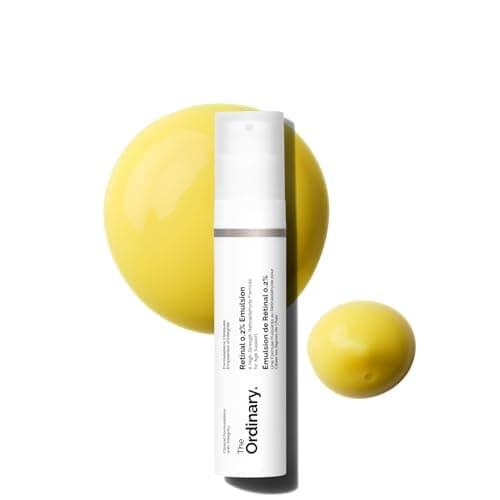
Buy it if you already tolerate a retinoid and want more without a prescription. Retinaldehyde is one enzymatic conversion away from retinoic acid, where retinol is two, so 0.2% retinal is doing more work than 0.2% retinol — and this is the nicest base The Ordinary puts a retinoid in. Do not buy it as your first retinoid. Start at the 0.2% retinol in squalane, earn your tolerance over a couple of months, and come back when two nights a week is boring. And if you are pregnant or trying to conceive, this is off the table entirely, along with every other topical retinoid.
This product is a ranked pick on our retinol roundup, where it is the step-up option rather than the overall winner. This page is the long version: the chemistry, the evidence as it actually reads, the stability problem nobody mentions, the ramp protocol, and the four groups who should leave it on the shelf.
What retinaldehyde is, and why the percentage misleads people
Every topical retinoid has to end up as retinoic acid to do anything, because retinoic acid is the molecule your retinoid receptors respond to. The conversion runs in steps:
retinyl esters → retinol → retinaldehyde → retinoic acid
A prescription tretinoin is retinoic acid already — no conversion, which is why it is both the most effective and the most irritating. Retinol needs two steps. Retinaldehyde needs one. That single step is the whole product: at the same label percentage, retinal arrives at the active form in greater quantity than retinol does, which is why a 0.2% retinal is not comparable to a 0.2% retinol despite the identical number on the carton.
The honest caveat: the published literature on topical retinoids is dominated by tretinoin, with a smaller body of work on retinol and adapalene, and comparatively little head-to-head clinical data on retinaldehyde at matched strengths. A systematic review comparing tretinoin to other topical photoaging therapies is clear that the prescription molecule remains the reference point. So the mechanistic argument for retinal is strong and the clinical comparison is thinner than the marketing implies, and we are not going to inflate it. Our retinol versus retinoid explainer sets out the whole family in order.
Published specifications
Read off the product listing. Nothing in this table was measured by us — we do not have a lab, and how we review says so in those words.
| Spec | What the listing states | What it means in use |
|---|
| Active | 0.2% retinaldehyde | One conversion step from retinoic acid, not two |
| Base | Emulsion | Lotion-like; no squalane slip, layers under a moisturizer |
| Strength disclosed | Yes, on the label | You can step up deliberately instead of guessing |
| Fragrance | Fragrance-free | One fewer variable while your skin is adjusting |
| Packaging | Small opaque tube | Correct for a light-sensitive active, and a short-lived product once opened |
The texture is the underrated part
The Ordinary's other retinoids sit in squalane, which is a fine vehicle chemically and a divisive one practically: an oil that stays slightly slick, does not layer well under anything, and makes oily skin feel coated. The emulsion here behaves like a thin lotion. It absorbs, it takes a moisturizer over the top without pilling, and it does not migrate toward your eyes overnight.
That sounds cosmetic, and it is the single biggest predictor of whether a retinoid works for you — because the retinoid that works is the one you are still applying in month four. Adherence is the mechanism nobody puts on a label.
The stability problem
Retinaldehyde is light- and air-sensitive, more so than retinol. The opaque tube is the right packaging decision, but the product still has a clock on it once you break the seal. Treat it as a consumable: keep it in a drawer rather than on a windowsill or a steamy shelf, close it properly, and finish it rather than rationing it for a year.
If you keep a skincare fridge, this is one of the few products where chilling has a defensible rationale — not because cold improves a retinoid, but because heat degrades one. Our does skincare expire guide covers which products actually have a shelf-life problem and which do not.
Who should not buy this
- Anyone pregnant or trying to conceive. Topical retinoids are contraindicated. This is not a cautious-internet rule, it is the standing medical one, and pregnancy-safe skincare covers what to use instead.
- First-time retinoid users. Starting here means a fortnight of flaking that most people read as an allergy, and then quitting retinoids entirely. Start two steps down.
- Anyone with a currently compromised barrier. If your skin is stinging, flaking or red right now, fix that first — a damaged barrier plus a potent retinoid is a two-month setback.
- Anyone already using an acid most nights. Pick one. Running an exfoliating acid and a retinal in the same week is the most common cause of the irritation people blame on the retinoid alone, and skin cycling exists to solve exactly that scheduling problem.
How it compares to the alternatives
| Option | Conversion steps to retinoic acid | Who it suits |
|---|
| The Ordinary Retinol 0.2% in Squalane | Two | A genuine first retinoid, at the lowest sensible strength |
| CeraVe Resurfacing Retinol Serum | Two (strength not disclosed) | Anyone who wants barrier ingredients in the same bottle |
| This product — Retinal 0.2% Emulsion | One | Someone already comfortable on nightly retinol |
| Differin Adapalene Gel 0.1% | None — a receptor-selective retinoid | Acne first, photoaging second; available over the counter |
| Prescription tretinoin | None — retinoic acid itself | The reference standard, with a prescription and the irritation to match |
The practical read: if you want acne results, adapalene is the better over-the-counter molecule and has the FDA indication to prove it. If you want photoaging results and you have already climbed the retinol ladder, this is the logical next rung.
How to ramp onto it without the fortnight of flaking
- Two nights a week for the first month. Not alternate nights. Not nightly. Most of the irritation stories are a frequency problem rather than a strength problem.
- Apply to dry skin, after cleansing, before moisturizer. A pea-sized amount for the whole face. More does not work faster; it only irritates faster.
- Buffer if you need to. Moisturizer first, retinal over the top, moisturizer again. It slows absorption slightly and that is the point during the adjustment weeks.
- Nothing else active on retinal nights. No acid, no benzoyl peroxide, no vitamin C in the same application — our retinol and vitamin C page explains why that particular pairing is a scheduling question rather than a ban.
- Sunscreen every morning, without exception. Retinoids increase photosensitivity, and a retinoid without sunscreen is work you are undoing each afternoon.
What it will not do
It will not fix deep set lines, it will not lift anything structural, and it will not work in three weeks. Retinoid results on texture and fine lines are measured over months, and the published trials that show the clearest effects run for 12 weeks or longer. Anything you see in the first fortnight is the adjustment phase, not the result.
It also will not do anything for pigmentation that sun exposure is still driving. If dark marks are the main complaint, pair it with the actives built for that job on best skincare for dark spots, and expect the sunscreen to do more of the work than the retinoid.