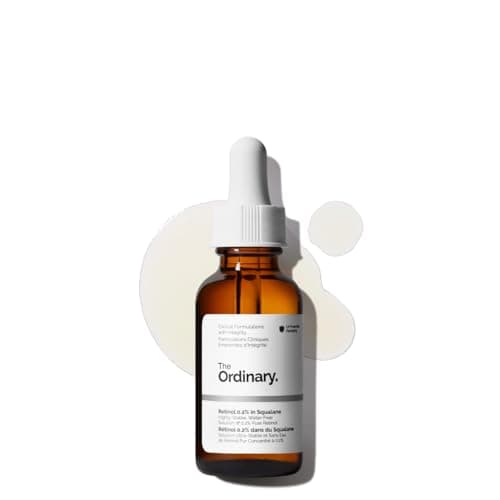
This is the least glamorous retinoid on the shelf and, for most people starting out, the correct one. It is a 30 ml amber dropper bottle containing eight ingredients, one of which is retinol at a stated 0.2%. There is no cream, no barrier complex, no peptide blend and no story. What you are buying is the cheapest way to find out whether your skin tolerates retinol at all — and that is a genuinely valuable thing to find out before you spend real money on a retinoid that comes with a moisturizer attached.
We rank it in our retinol roundupas the starter strength: the rung you begin on rather than the rung you stay on. This page is the long version. Every figure below comes from the current published ingredient list, the manufacturer's own directions, or named peer-reviewed research — none of it from memory, and we have not lab-tested this bottle. Our method page says exactly what that means.
Who it's for
Buy it if you have never used a retinoid, your skin runs normal to dry, and you want to establish tolerance on something cheap enough that abandoning it costs you nothing. It is also a reasonable long-term maintenance strength for someone who tried a stronger retinoid, could not stay consistent with it, and would rather use a mild one four nights a week than a strong one twice a month.
Do not buy it ifyou want one bottle that treats and moisturizes. This is an anhydrous oil with a single active in it, by design, and it will not do the second job. Skip it too if you are already using a retinoid — the brand says plainly not to combine it with other retinoid products — and skip it if you are pregnant or breastfeeding, where the brand's own guidance is to avoid retinoids entirely.
One more group should walk past: people whose actual complaint is active acne rather than texture or early lines. A 0.2% cosmetic retinol is a slow, general-purpose renewal step. Adapalene is an over-the-counter retinoid indicated for acne, and it will get you there faster. Our retinol vs retinoid explainer sorts out which rung of that ladder your problem sits on.
The ingredient list, decoded
The current list is eight ingredients long, in this order: squalane, caprylic/capric triglyceride, jojoba seed oil, retinol, tomato fruit extract, rosemary leaf extract, hydroxymethoxyphenyl decanone, BHT. That is it. Three of those are the vehicle, one is the active, and four are there to keep the active from falling apart.
There is no water in it.That single fact explains most of what is confusing about this product. It is an oil serum, not a lotion — the squalane, the caprylic/capric triglyceride and the jojoba are lipids, and lipids seal rather than hydrate. Our face oil roundup makes the same point about the whole category: a product with no water and no humectant in it cannot add moisture to your skin, it can only slow the moisture you already have from leaving. If your face feels tight under this, the fix is a moisturizer underneath or over it, not more of this.
Retinol sits fourth, and that is fine.Ingredient lists run in descending order of concentration only down to 1%, and below that a brand may list in any order — so a 0.2% active landing behind three carrier lipids is exactly what you would expect and tells you nothing bad. What it does tell you is the ratio: this bottle is overwhelmingly squalane, which is the gentlest, least reactive emollient in common use and a sensible thing to suspend an irritant in.
No fragrance, no parfum, no essential oil, no alcohol.The rosemary leaf extract is there as an antioxidant, not a scent, and it is the only botanical on the list. For a category where fragrance is routinely added to cover the smell of the base, that is a clean sheet — and it is why this product keeps turning up on our sensitive skin shortlists despite being an irritant by mechanism.
The reformulation nobody announced
Here is something we have not seen written about anywhere, and it is checkable against the public ingredient databases: this formula is not the one it launched with. The earlier version ran to six ingredients — squalane, caprylic/capric triglyceride, retinol, tomato fruit extract, jojoba seed oil, BHT. The current version has eight. Two antioxidants were added — rosemary leaf extract and hydroxymethoxyphenyl decanone— and jojoba moved up above retinol in the order.
Both additions point the same direction. Retinol's problem in a bottle is not formulation elegance, it is oxidation, and the fix is a stack of antioxidants that get consumed before the retinol does. The original formula had two of those (tomato fruit extract and BHT). The current one has four. Read charitably — and we think charitably is correct here — the brand looked at how fast the first version degraded and spent money on keeping it alive longer.
Why it matters to you: if you are reading an older review of this product, it was written about a different bottle. And if you have an old one in a drawer, it is the less protected formula and it is older, which is two strikes against the one specification that actually governs whether a retinol works.
The printed percentage is a claim, not a measurement
The main reason to buy from The Ordinary is that the number is on the front of the box, and we say so on every page where this product appears. It deserves one honest caveat that the brand's fans rarely make.
A Slovenian analytical group ran chromatographic quality control on commercial retinoid cosmetics and published the results in the International Journal of Cosmetic Science. Where a product declared a quantity, the measured content deviated from the declared figure across a 0%–130% range in seven of the products tested, and in more than half of the products there were inconsistencies between the retinoid actually present and the one named on the label. Two products contained retinoic acid, which is not permitted in cosmetics.
That study did not test this product, and we are not implying anything about this bottle specifically — we have no measurement of our own and we are not going to invent one. The point is narrower and it is about how much credit a printed percentage earns. A stated percentage buys you transparency, which is real and rare. It does not buy you verification. Nobody in the consumer market is checking these numbers, and the honest position is that 0.2% is what the brand intends to be in the bottle on the day it is filled.
What 0.2% actually buys you
Calibrate your expectations against the research rather than the marketing. The trial most often cited for cosmetic-strength retinol is Kafi and colleagues in Archives of Dermatology (2007), a randomized, vehicle-controlled study in 36 elderly subjects that applied 0.4% retinol lotion up to three times a week for 24 weeks. It found a significant improvement in fine wrinkling against vehicle, plus increased glycosaminoglycan expression and procollagen I.
Two things follow. First, retinol at cosmetic strength genuinely does something — this is not a category where the evidence is thin. Second, and this is the part that gets left out: 0.4% is double what is in this bottle, and the result took six months of consistent use to show up. A 0.2% retinol is half the strength that produced it. It is a real retinoid, and it is the low end of a real one.
So the honest framing is that this product is a tolerance testand a maintenance strength. If your skin handles it comfortably after eight weeks, the useful next move is to step up — to the 0.5% or 1% in the same base, or sideways to a stronger retinoid class— rather than to keep expecting more from this one. The thing it is genuinely best in the world at is costing almost nothing while you find out.
The instruction almost nobody follows
The manufacturer's own directions include a line most buyers never read: refrigerate after opening. We have read a lot of skincare labels and this is a rare thing for a brand to print, because it is an inconvenient thing to ask of a customer. It is also correct.
Retinoid stability research published in the Journal of Cosmetic Dermatology(2021) tracked sixteen retinoid derivatives across twelve commercial cosmetic products over six months. At normal room conditions the products lost between 0% and 80% of their retinoid content. At elevated temperature the losses ran from 40% to 100%. Light-driven breakdown outpaced temperature-driven breakdown, and packaging mattered — a clear jar performed worse than opaque, air-excluding packaging.
Which reframes two things about this bottle. The amber glass is not styling; it is the light half of that problem being handled. And the fridge instruction is the temperature half, which the packaging cannot handle for you. If you own a skincare fridge, this is the single product on your shelf with the strongest case for going in it — not because cold feels nice on the skin, but because the active is measurably perishable and the manufacturer says so.
What using it is actually like
The directions are a few drops to the face in the evening, on unbroken skin, with the brand advising a patch test first. The texture is a thin, slippery, faintly yellow oil that spreads much further than you expect — three or four drops covers a whole face, and using more is the most common self-inflicted cause of irritation here.
It absorbs slowly and leaves a light sheen. Oily and combination skin often dislikes that; the brand's own suitability note for this product is “suited for dry skin”, and we would take that at face value. If you have oily skin and want a retinoid, the emulsion formats in the same range are a better texture match.
Start at two nights a week for the first month. Expect an adjustment period — the brand warns of irritation, redness and peeling around the eyes and mouth while tolerance builds, and that warning is accurate. Expect visible texture change at around eight to twelve weeks and tone change later than that. Do not expect it to fix a blemish this week; that is not what this is. And if you push through irritation rather than backing off, you end up with a damaged barrier, which looks a great deal like the aging you bought the retinol to treat.
The conflict list, and the sunscreen clause
The brand advises against combining this with copper peptides, direct acids, direct vitamin C, other retinoids and its Multi-Active Delivery Essence. Against a normal shelf that means retinol night is retinol night: it displaces your exfoliating acid rather than joining it. Our retinol and vitamin C guide covers how to split those across morning and evening instead of stacking them.
And the clause you do not get to skip: use sun protection during the day. A retinoid accelerates cell turnover, which leaves newer skin at the surface, and using one without daily sunscreenis close to self-defeating — you spend six months improving fine lines while adding pigment. If you are not going to wear sunscreen, do not start a retinoid.
How it compares
Against the 0.5% and 1% in the same base: identical vehicle, more active. The step up is the point of the range, and the honest advice is to earn it rather than start there. Nothing about a 1% retinol is better if it makes you quit in week three.
Against the brand's retinal emulsion: retinaldehyde sits one conversion step closer to retinoic acid than retinol does, so a 0.2% retinal is meaningfully stronger than this 0.2% retinol despite the matching number. It is the right second bottle, not the right first one, and it comes in a smaller 15 ml size.
Against a retinol cream with a barrier complex in it: a cream does two jobs and costs several times as much; this does one job and costs less than lunch. If you already own a moisturizeryou like, you do not need the cream — you need this plus the moisturizer you already own. If you own nothing, the cream is the more forgiving purchase.
Against adapalene: different problem. Adapalene is a true retinoid indicated for acne and it will beat this on breakouts decisively. On general texture and early lines for someone with no acne, this is the gentler and cheaper entry point.
The verdict in one line
An eight-ingredient, water-free, fragrance-free retinol oil with the percentage printed on the box, sold for less than almost any other way of finding out whether your skin tolerates a retinoid — held back by a strength that is half what the best-known cosmetic retinol trial used, a texture that suits dry skin and annoys oily skin, and an active that starts degrading the day you open it unless you do what the label says and put it in the fridge. If you are starting from zero, start here. If you have been here a year and your skin is comfortable, the bottle has done its job and it is time to step up.