Skip to content
Barrier & Bloom

Single reviews · Reviews

La Roche-Posay Toleriane Double Repair review: the pharmacy moisturizer worth the upgrade

We decoded the ceramide-and-niacinamide formula behind the pharmacy aisle's most recommended moisturizer. Here's what the extra money buys over a drugstore ceramide cream — and when it doesn't.

By Stephen V.Updated How we review
#ad

We earn a commission when you buy through our Amazon links, at no extra cost to you. It never changes a verdict, and we say so when the cheaper product is the better buy. How this works.

Verdict:this is the best-textured barrier moisturizer at its price, and the one we recommend to people who found CeraVe's tub too heavy and everything at a cosmetics counter too expensive. Ceramide-3, niacinamide, glycerin and La Roche-Posay's prebiotic thermal water in a fragrance-free lotion that absorbs in seconds and sits invisibly under sunscreen. It costs roughly a third more than a comparable drugstore cream and delivers roughly a third more elegance — an honest trade, and not a transformative one.

Our method, stated plainly: we did not lab-test this moisturizer.We decoded the full published ingredient list, compiled the brand's documented specifications, and compared the formula against the other ceramide moisturizers in the category — the identical method we apply to everything on this site, described on how we review.

Who it's for

Normal to dry skin that wants a daily face moisturizer rather than a body-and-face tub. It is the sensible pick for anyone using a retinoid or an acid, because it is the sort of fragrance-free ceramide lotion that makes those actives survivable. It suits sensitive and eczema-prone skin — Toleriane is La Roche-Posay's reactive-skin range — and it is light enough for combination skin, which is where it beats the CeraVe tub outright. It appears in our sensitive-skin roundup and our rosacea roundup for those reasons.

Who should look elsewhere: anyone with genuinely oily skin, who will find even this lotion slightly rich by afternoon, and anyone buying on strict value, for whom the CeraVe or Vanicream options in our drugstore roundup deliver the same category of benefit for less.

The ingredient list, decoded

Glycerin sits high on the list — the single most reliable humectant in cosmetics, and the reason this feels hydrating immediately rather than after three weeks. Ceramide NP (ceramide-3) is the headline barrier lipid, and niacinamide supports the barrier from a different direction while calming visible redness. La Roche-Posay Prebiotic Thermal Wateris the brand's signature: selenium-rich spring water positioned as microbiome-supporting. Our honest read is that the evidence for the microbiome claim specifically is thinner than the marketing implies, while the water itself is a perfectly good, mineral-containing base.

The texture system is where the money goes: dimethicone for a silky, non-greasy occlusive film, shea butter and caprylic/capric triglyceride as emollients, and pentylene glycol. There is no fragrance, no parabens, no drying alcohol. That combination — real barrier lipids, real humectants, a silicone for slip, and nothing added for smell — is why it disappears on skin in a way that thicker ceramide creams do not.

What the extra money actually buys

Be clear-eyed here. Compared with CeraVe Moisturizing Cream, the Toleriane gives you: a lighter, faster-absorbing texture; a tube rather than a tub, so no fingers in the pot; and niacinamide as a stated inclusion. What it does not give you is a fundamentally better barrier formula — CeraVe's three ceramides plus cholesterol plus phytosphingosine is arguably a more complete lipid story than a single ceramide-3. If you are choosing on formula alone, CeraVe wins. If you are choosing on daily-use pleasantness for a face, this wins. Both answers are defensible and we would rather give you both than pretend there is one.

Living with it

It absorbs in under a minute with no tackiness and no pilling under sunscreen, which is the practical test most moisturizers fail. The tube is hygienic and travels well. The finish is matte-satin rather than dewy. In deep winter or on very dry skin it may need a heavier occlusive over the top at night; on combination skin in summer it is exactly right. There is no scent to speak of, which for a fragrance-free product is the point.

How it compares

CeraVe Moisturizing Cream is richer, cheaper and arguably the better formula, but heavier. Vanicream Daily Facial Moisturizer has the shortest ingredient list of the three and is the safest for genuinely reactive skin, at the cost of feeling more basic. CeraVe's AM and PM facial lotions are the closest direct analog and undercut it on price. Where the Toleriane wins is the specific combination of a genuinely light texture with a genuinely good barrier formula, which is rarer than it should be.

The verdict in one line

The best daily face moisturizer for sensitive skin that also has to work under sunscreen and makeup — worth the modest upgrade over drugstore ceramide creams if texture matters to you, and entirely skippable if it does not.
01
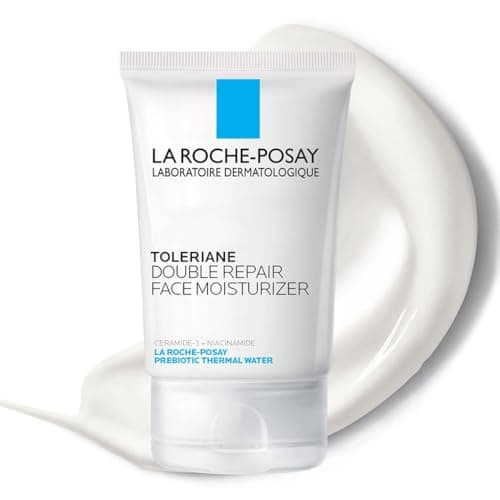
La Roche-Posay La Roche-Posay Toleriane Double Repair Face Moisturizer

Normal to dry, sensitive skin

La Roche-Posay Toleriane Double Repair Face Moisturizer

Ceramide-3NiacinamidePrebiotic thermal waterFragrance-free
8.4/10

The best-textured barrier moisturizer at its price. Ceramide-3, niacinamide and glycerin in a fragrance-free lotion that absorbs in seconds — a real upgrade in daily pleasantness over drugstore ceramide creams, and not a formula revolution.

Formula
9
Results
8
Gentleness
9
Texture
9
Value
7

Pros

  • Absorbs in under a minute with no pilling under sunscreen
  • Genuine barrier ingredients rather than emollients alone
  • Fragrance-free, paraben-free, alcohol-free — safe for reactive skin
  • Tube packaging keeps fingers out of the product

Cons

  • Roughly a third more expensive than comparable drugstore ceramide creams
  • A single ceramide, where CeraVe's formulas use three plus cholesterol
  • The prebiotic microbiome positioning outruns the available evidence

Don't buy this if…

your skin is genuinely oily, or you are buying strictly on value — CeraVe and Vanicream cover the same ground for less.

A practical note: this is the moisturizer we would pair with a first retinoid. It is light enough to apply before and after the active without feeling like three layers, and fragrance-free so it adds nothing to the irritation load.

$24.99View on Amazon

Price as of Aug 28, 2026. Prices change — Amazon's at checkout is the one that counts.

#ad · we may earn a commission from this link to La Roche-Posay Toleriane Double Repair Face Moisturizer

How we picked

We did not lab-test this gear

Everyone in this category says they tested twenty products. We have not lab-tested any of these, and we say so. What we did instead: compiled the published specifications, decoded the ingredient (INCI) lists active by active, ran the math where there was math to run, and scored each product against a published rubric. The scores are judgments from documented research — not measurements we took, because we do not have a lab and we will not pretend we do. Where a number came from someone else's work, we name them in Sources.

Questions

Frequently asked

Is Toleriane Double Repair better than CeraVe Moisturizing Cream?
Better textured for daily face use; arguably not better formulated. CeraVe uses three ceramides plus cholesterol and phytosphingosine, which is a more complete barrier lipid story. The Toleriane is lighter, absorbs faster and comes in a tube. Choose on texture, not on which is 'better'.
Is it good for oily skin?
For combination skin, yes. For genuinely oily skin it is still slightly rich by afternoon — a gel-cream or a CeraVe AM lotion suits better. The barrier ingredients are useful regardless of oiliness, so do not skip moisturizer entirely just because you are shiny.
Can I use it with retinol?
Yes, and it is one of the better pairings there is. Fragrance-free, ceramide-containing and light enough to apply both before and after the retinoid as a buffer, which is the standard technique for surviving the adjustment period.
Does the prebiotic thermal water do anything?
It is a mineral-rich spring water and a perfectly reasonable base. The specific microbiome-supporting claim is where the marketing runs ahead of the published evidence, and we would not pay a premium for it. The ceramide, niacinamide and glycerin are doing the work.
Is there an SPF version?
There is a separate Double Repair UV moisturizer with SPF 30. If you want one product for both jobs it is a reasonable option, but we generally prefer a dedicated sunscreen applied at a proper dose — see our face sunscreen roundup for why the dose matters so much.
Is it non-comedogenic?
It is formulated and labeled as such, and the lightweight silicone-and-glycerin base is not a typical pore-clogging combination. As always, individual skin varies — patch-test along the jaw for a few days if you break out easily.

Keep reading

Receipts

Sources

We do not run a testing lab, and we do not pretend to. Where a measured number came from someone else's work, we name them and link them. Where we could not verify something, we say so on the page rather than quietly leaving it out. Read our full method.