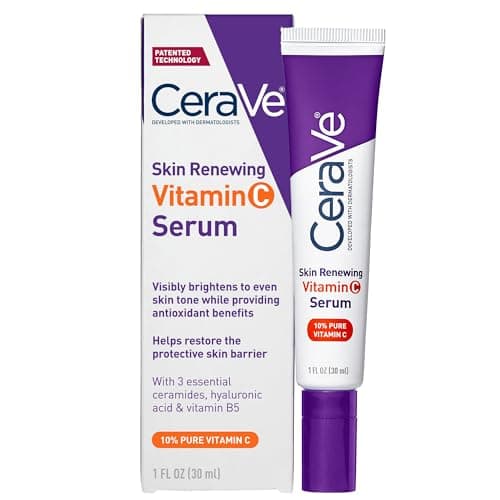
Buy it, and buy it as a habit rather than as a hero product. This is the vitamin C serum we rank first on our roundup, and it wins there for an unglamorous reason: it is real L-ascorbic acid at a sensible strength, in a base that does not sting, in packaging that slows the oxidation this ingredient is famous for, at a price that makes using it every morning for a year a non-decision. The enthusiast formulas beat it on paper. This is the one most people are still using in six months, and with vitamin C that is the variable that decides whether anything happens at all.
It is also the product where we have to tell you what we do not know. The one specification that most determines how much 10% L-ascorbic acid actually reaches skin is the formula pH, and CeraVe does not publish it. We will come back to that, because it is the honest ceiling on this review and on every review of this product that does not mention it.
What is in the bottle
The listing is specific about the headline: 10% pure vitamin C — meaning L-ascorbic acid, the most-studied form — with hyaluronic acid and ceramides, in a 1 fl oz bottle with an opaque, air-limiting pump. It is fragrance-free, and it sits in a line built around barrier repair rather than around actives, which turns out to be the most interesting thing about it.
Three of those four facts matter more than the percentage.
The form.L-ascorbic acid is the version behind most of the published work on topical vitamin C: an antioxidant that neutralizes oxidants generated by UV and pollution, a required cofactor for the prolyl and lysyl hydroxylases that stabilize the collagen triple helix, and an interference in melanin synthesis, which is the honest mechanism behind the word "brightening." Everything else in the category — sodium ascorbyl phosphate, ethyl ascorbic acid, tetrahexyldecyl ascorbate, ascorbyl glucoside — is a derivative that has to be converted in skin first. Our vitamin C derivatives guide goes through them one at a time. This one skips the conversion step.
The base. This is the actual differentiator, and it is the reason we rank it above more potent serums. Nearly every L-ascorbic acid serum is water, a glycol, the acid, and as little else as the formulator can get away with — because the acid does not like company. CeraVe put it in a base carrying skin-identical ceramides and hyaluronic acid, which is the opposite instinct. The result is a low-pH active that most people can apply to a whole face every morning without the hot, tight ten minutes a 20% ferulic serum produces. If you have ever bought a boutique vitamin C, used it four times and shelved it, this is the specific problem being solved.
The packaging.Opaque, with a pump rather than a dropper. Vitamin C is a shelf-life product: ascorbic acid oxidizes to dehydroascorbic acid and then degrades further, and light, air and warmth all accelerate it. The visible tell is color — a fresh L-ascorbic acid serum is near-colorless, and it drifts to yellow, then orange, then brown. A clear glass dropper bottle is the worst possible container for this ingredient and remains the industry's favorite. Opaque plus a limited air path is the single biggest predictor of how long a bottle stays worth using, and it is worth more than two extra percentage points of acid.
The pH question we cannot answer
Here is the caveat, stated plainly because it is load-bearing. L-ascorbic acid only crosses the stratum corneum appreciably when it is largely un-ionized, which in practice means a formula pH below roughly 3.5. Above that, more of the acid is in a charged form and less of it gets in. This is why a serum that lists 15% or 20% at an unknown pH can deliver less than a well-formulated 10%, and it is the single most important number in the category.
CeraVe does not publish it. Neither do most brands, and we are not going to estimate a figure and present it as a fact — our method pagecommits us to saying "unknown" instead. So the honest shape of this review is: the form is right, the strength is sensible, the base and the packaging are better than the category average, and the one variable that would let us say how much of the 10% is bioavailable is not disclosed. If a brand ever starts printing formula pH on the carton, it will deserve to win on that alone.
A practical consequence: the people most likely to be disappointed are the ones chasing a specific percentage. If what you want is a maximum-dose antioxidant serum and you can tolerate one, a published 20% L-ascorbic acid with vitamin E and ferulic acid is a different product with a different trade-off, and we rank one second on the roundup.
What it will and will not do
What it does, on a realistic timeline. Daily use of a topical L-ascorbic acid serum is best understood as antioxidant support: it sits alongside sunscreen and reduces the oxidative load UV leaves behind, which is a prevention story rather than a correction one. Over two to three months, most people who use one consistently report a more even tone and a slightly brighter look. On post-inflammatory marks — the flat brown or red shadows a healed spot leaves — it is a slow helper, not a solvent.
What it does not do. It does not replace sunscreen; it works with one, and the one is doing more. It does not erase dark spots in a week, and it does not do much at all for melasma, which is a harder problem with better tools — our dark-spot page and tranexamic acid are the right starting points there. It will not plump a wrinkle. And the collagen mechanism is real biochemistry that we would not oversell: being a required cofactor for an enzyme is not the same as being a demonstrated driver of dermal collagen in a human face, which is a distinction we make at length on our collagen guide.
How it compares
Five formats, ordered by how hard they push, so you can see where this one sits rather than whether it is "good."
| Format | What you get | What it costs you |
|---|
| A gentle derivative serum | No sting, long shelf life, works on reactive skin | Needs conversion in skin; weakest evidence of the five |
| This serum: 10% L-ascorbic acid in a ceramide base | Real L-ascorbic acid most people tolerate daily, opaque pump, drugstore price | Mid-strength; formula pH undisclosed |
| 20% L-ascorbic acid with vitamin E and ferulic acid | The classic high-dose antioxidant trio, published strength | Stings, oxidizes faster, wants a fridge |
| The original prestige C E ferulic formula | The most-cited formulation in the category | Many times the price for the same three actives |
| A prescription retinoid instead | The strongest evidence of anything in this table for aging skin | Irritation, a ramp-up period, a doctor, and not an antioxidant |
The most common mistake we see is treating rows two and three as better and worse versions of the same thing. They are different trades: tolerability and shelf life against dose. If you have already failed at row three, row two is the answer and not a compromise.
How to use it so it is not wasted
- Morning, on clean dry skin, before everything else. A thin layer, then moisturizer, then sunscreen. Antioxidant plus UV filter is the pairing the evidence supports; vitamin C alone in the morning is half a routine.
- Do not layer it directly with a retinoid. Not because it is dangerous, but because the two want different conditions and the combination is a reliable way to irritate yourself. Vitamin C in the morning, retinoid at night. The full version of this is on retinol and vitamin C.
- Keep it capped, cool and out of the window. Heat and light are what turn it orange. If you own a skincare fridge, vitamin C is the one product in your routine with a real reason to live in it.
- Watch the color, not the date. Pale straw is fine. Orange means it is well down the oxidation path, and brown means replace it. This is the one product where we would rather you bought the smaller bottle more often.
- Give it eight to twelve weeks before judging it. Nothing in this category performs on a two-week timeline, whatever the review grid says. Our how long skincare takes to work page has the honest ranges.
Who should not buy it
- Anyone whose skin stings from most actives. A ceramide base helps and it does not make a low-pH acid gentle. A derivative is the better route, and our sensitive-skin roundup starts from that assumption.
- Anyone already using and tolerating a 20% ferulic serum. This is a step sideways and slightly down in dose. Stay where you are.
- Anyone treating stubborn melasma. Vitamin C is a supporting player there at best. Go straight to the pigment-specific tools.
- Anyone who will not wear sunscreen. The antioxidant case rests on pairing. Buy the sunscreen first; our face sunscreen roundup is the better place for that money.