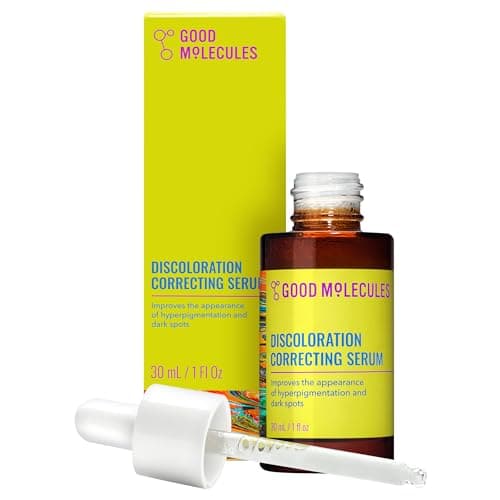
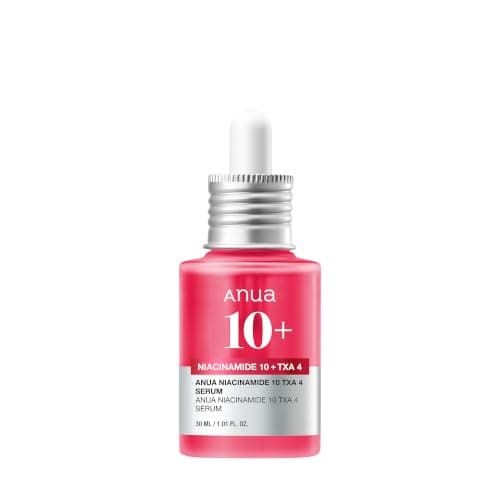
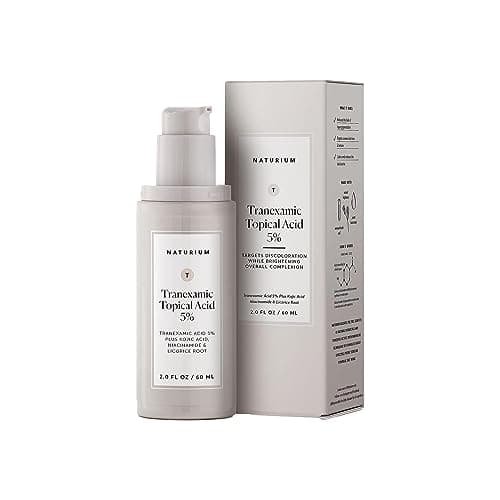
Tranexamic acid is a synthetic derivative of the amino acid lysine, originally used as a medication to reduce bleeding. Applied topically, it turns out to interfere with the signaling between skin cells and the pigment-producing melanocytes underneath — which is a genuinely different mechanism from most brightening ingredients, and the reason it sometimes helps discoloration that everything else has failed to shift.
Most brighteners work at the pigment factory: they inhibit tyrosinase, the enzyme that makes melanin. Tranexamic acid works one step earlier, on the message that tells the factory to start. That upstream position is why it has become the ingredient dermatologists reach for in melasma, where the trigger — hormonal, vascular, UV — is the problem rather than the pigment machinery itself.
What the evidence supports
The strongest published work on tranexamic acid is on melasma, and most of it studies oral or injected forms under medical supervision rather than a serum from a shelf. Topical studies exist and are broadly positive, but they are smaller and the effect sizes are more modest. The honest summary: topical tranexamic acid is a credible pigmentation ingredient with a real mechanism, at a meaningfully lower level of evidence than the oral form it borrows its reputation from.
Two things follow. First, do not expect a serum to do what a supervised course of oral tranexamic acid does — that is a prescription decision with real contraindications, including clotting risk, and it is not something to seek out on the strength of a skincare article. Second, at the same time, a topical is a low-risk thing to try before escalating.
Strengths and formulation
- 2% to 5% is the usual at-home range, and 5% is where most of the serious over-the-counter formulas sit. Higher numbers are rare and not obviously better.
- It is almost always formulated with partners — niacinamide, kojic acid, alpha arbutin, licorice root — because pigmentation responds better to several mechanisms than to one. That is legitimate formulation rather than filler.
- It is not photosensitizing, unlike the acids used for the same goal, which means it can be used morning and night without adding UV risk of its own.
Who it suits
The best candidates are people with stubborn, patchy discoloration that has not responded to alpha arbutin, azelaic acid or vitamin C — particularly if the pattern is symmetrical across the cheeks or upper lip, which is the classic melasma distribution. It is also well tolerated, so it is a reasonable choice for skin that reacts to acids.
It is less obviously the right tool for post-acne marks, where azelaic acid treats both the pigment and the inflammation that produced it, or for straightforward sun spots, where alpha arbutin is cheaper and equally reasonable. Our dark spots roundup sorts those cases out product by product.
How to use it, and the timeline
Once or twice daily, after cleansing, before moisturizer. Use one pigmentation active rather than three — stacking brighteners produces irritation, and irritation produces the inflammation that generates more pigment, which is the exact loop you are trying to break.
Give it twelve weeks before judging. Then, critically: none of this works without daily broad-spectrum sunscreen. Melasma in particular is triggered by visible light as well as UV, which is why dermatologists recommend tinted mineral sunscreens for it — the iron oxides that provide the tint also block visible light. That detail is worth more than any serum on this page.
The honest ceiling
Melasma is a chronic, relapsing condition influenced by hormones, heat and light. Topical tranexamic acid can lighten it; nothing over the counter cures it, and it commonly returns with a summer, a pregnancy or a change in contraception. If a symmetrical patchy discoloration is bothering you enough to be reading this, the highest-value next step is a dermatologist rather than a fourth serum — both for a diagnosis and because the effective options at that point are prescription ones.