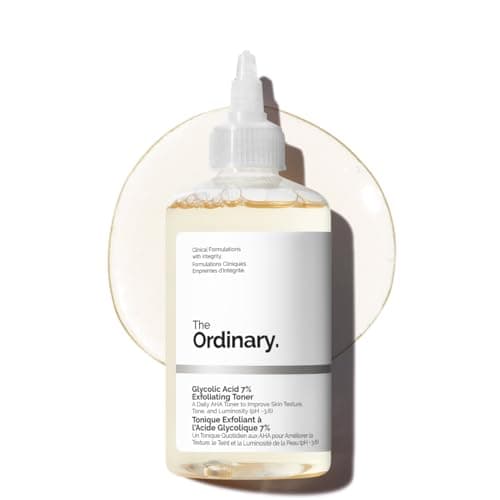
This is the most cost-effective way to put a genuinely functional AHA on your face, and the reason is boring: the acid is real, the pH is published and correct for it, and the rest of the bottle is a well-built humectant base rather than filler. At roughly eight ounces it also lasts long enough that most people never do the math on cost per use. The condition attached is the same one that applies to every glycolic product — it is the harshest of the common AHAs, and a large bottle of it is an easy thing to overuse.
A naming note first, because it causes real confusion: this product used to be sold as Glycolic Acid 7% Toning Solution and is now Glycolic Acid 7% Exfoliating Toner. Same product, renamed. If you are comparing an older review to the current bottle, you are looking at the same thing under two labels.
We rank it in our chemical exfoliant roundup as the workhorse AHA for robust skin. This page is the long version, and every figure below comes from the product's own ingredient list or the manufacturer's published directions — not from memory.
Who it's for
Buy it if your skin is oily, normal or robust, your complaint is dullness and rough surface texture rather than blackheads, and you want a leave-on acid you can build to several nights a week and keep using for years.
Do not buy it if your skin flushes easily, you have rosacea, or you use a retinoid nightly. The manufacturer says the same thing more bluntly on its own page: do not use on sensitive, peeling, or compromised skin. If that is you, a lactic or mandelic acid does the same job with a molecule large enough to be forgiving — our AHA vs BHA comparison routes each skin type to the right acid.
And if your actual complaint is blackheads or congestion, this is the wrong family altogether. Glycolic is water-soluble and works on the surface; a 2% BHA is oil-soluble and works inside the pore. Buying an AHA for a BHA problem is the most common way people conclude that acids do not work for them.
The ingredient list, decoded
Glycolic acid is the second ingredient, immediately after water. On a descending-order list that is exactly where a stated 7% should sit, and it confirms the number is doing real work rather than decorating the label.
What surprises people is what comes next. After three botanical waters — rose, cornflower and aloe — the formula runs through an unusually long humectant and skin-identical complex: twelve amino acids (aspartic acid, alanine, glycine, serine, valine, isoleucine, proline, threonine, histidine, phenylalanine, glutamic acid and arginine), plus PCA and sodium PCA, sodium lactate, urea, and the sugars fructose, glucose and sucrose.
That list is close to a textbook description of the skin's own natural moisturizing factor, and it is the single most underrated thing about this product. It is why a 7% glycolic at a low pH is more tolerable than the numbers suggest — the acid exfoliates while the base actively holds water in. Most cheap glycolic toners do neither half well. This one does the second half unusually well for the money.
There is no alcohol in it. The formula is alcohol-free, which is worth calling out because a great many glycolic toners in this price bracket use denatured alcohol as a solvent and penetration aid, and that is precisely the combination that turns an exfoliant into a barrier problem. Our guide to reading an ingredient list covers how to tell a drying alcohol from a harmless fatty one.
There is also no declared fragrance — no fragrance, parfum or essential oil on the list. It does contain rose and cornflower flower waters, which are botanical waters rather than a fragrance blend; they are not a declared allergen, but very reactive skin occasionally responds to botanical waters, so it is worth knowing they are there.
One genuine curiosity: the list includes hexyl nicotinate, an ingredient with little public documentation in cosmetics beyond a reference that it increases blood flow. We are not going to build an argument on that — the published information is thin, and we would rather say so than speculate about what it contributes to the immediate after-glow.
The pH, and why it is the number that matters
Concentration alone does not determine how strongly an acid acts. pH does at least as much work, because it governs how much of the acid is in its active free form. The Ordinary publishes this product at pH 3.5-3.9, describing roughly 3.6 as the balance it targets.
That is the right window. Below about 3, an acid gets aggressive without getting more useful; much above 4 and a 7% glycolic starts behaving like a 3%. Publishing the figure at all is creditable — most brands in this price bracket do not, which leaves you unable to tell whether the percentage on the front means anything. Between the stated concentration, the published pH and the ingredient position, this is one of the few cheap acids you can actually evaluate before buying.
What using it is actually like
The directions are once daily, ideally in the evening, on clean skin, swept over the face with a cotton pad or fingertips. If you are new to acids the brand advises starting at two or three times a week and building. Take that seriously: with a bottle this size there is no economic pressure to ration it, and nightly use from a standing start is the most common way people over-exfoliate with this specific product.
Expect a brief tingle. Expect visible smoothing and a more even light-reflection within two to three weeks, and genuine tone improvement over two to three months. Do not expect it to clear blackheads, and do not expect it to do anything for deep lines — that is a retinoid's job, and the two should not be run on the same night.
A detail almost nobody mentions: the manufacturer also directs this product for scalp use, three times a week. That is an unusual official instruction and a legitimately useful one if flaking is your issue — though it is worth patch-testing, and worth not doing in the same week you are also building tolerance on your face.
The layering list, and the sun clause
The Ordinary advises against combining this with direct acids, retinoids, direct vitamin C, copper peptides, peptides, niacinamide powder and EUK-134. Read against a normal shelf, that means glycolic night is glycolic night — it displaces your retinoid rather than joining it.
And the clause people skip: the label carries the AHA sun-sensitivity warning, advising sunscreen, protective clothing and limited sun exposure while using it and for a week afterwards. That matches the FDA's own position on AHA-containing cosmetics. A week, not a morning. If you are not going to wear daily sunscreen, an AHA will cost you more in pigmentation than it gains you in smoothness.
How it compares
Against the AHA 30% + BHA 2% peel from the same brand: these are different categories, not two strengths of one thing. The 30% peel is a ten-minute rinse-off reset for experienced users; this is a leave-on maintenance step. For most people the toner used two or three nights a week produces the better long-run result with a far smaller downside, and if you own only one of them it should be this one.
Against a 2% BHA: different problems. Surface dullness and texture go to this; blackheads and congestion go to the BHA. Neither substitutes for the other.
Against lactic or mandelic acid: those are the better starting acids for anyone who is unsure, dry or reactive. Glycolic is the smallest AHA molecule and therefore the fastest and the harshest — the reason our glycolic acid guide keeps it at the robust-skin end of the family.
The verdict in one line
A properly formulated 7% glycolic at a published, correct pH, in an alcohol-free base with a genuinely good humectant complex, at a price that makes it the default recommendation for anyone with robust skin who wants a leave-on AHA — and the wrong purchase for anyone whose skin flushes, peels or already runs a nightly retinoid. If you are in that second group and bought it anyway, our damaged barrier guide is the page you need next.