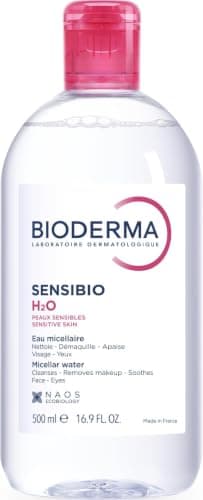
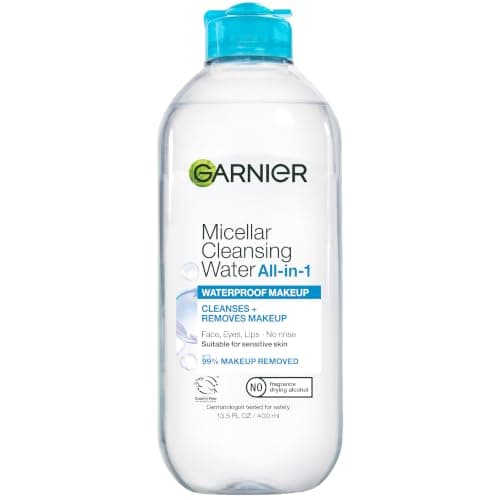
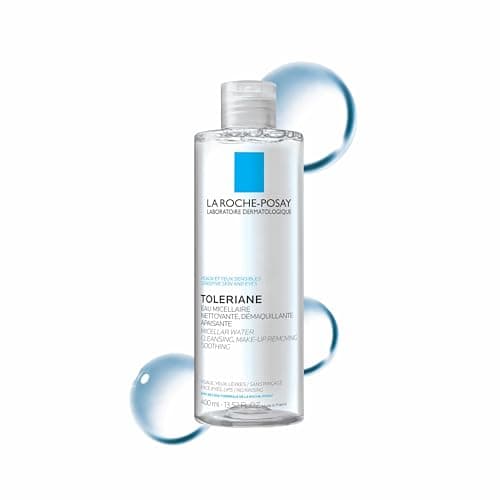
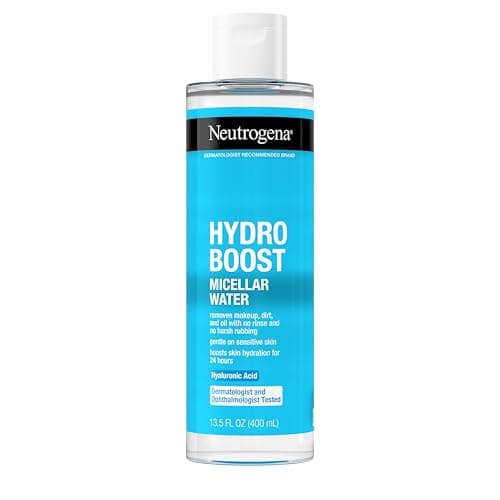
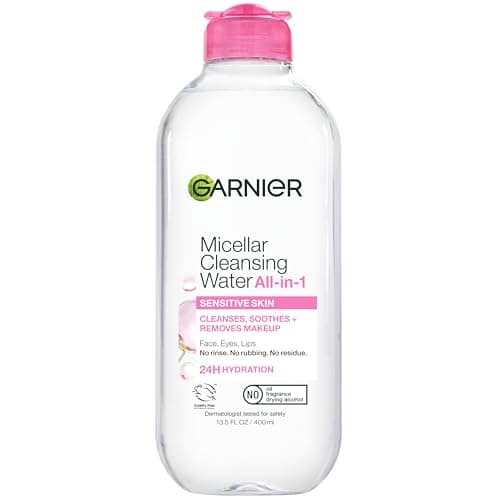
Buy the Garnier, and treat it as step zero rather than as your cleanser. It lifts a full face of makeup with fewer passes than anything else at its price, it is the cheapest per ounce on this page by a distance, and it is sold in a form most drugstores carry. The upgrade worth paying for is Bioderma Sensibio H2O if your skin is genuinely reactive — the original product in the category, and still the one with the shortest, calmest ingredient list.
The more important thing this page can tell you is what micellar water is, because the category's marketing has quietly turned a makeup remover into something people use instead of washing their face. It is a dilute surfactant solution. Its job is to get makeup, sunscreen and the day's oil off onto a cotton pad. It is excellent at that. It is not a face wash, it is not a toner, and the instruction not to rinse rests on less evidence than you would expect.
What micellar water actually is
A micelle is not a new technology. Put enough surfactant in water and above a certain concentration — the critical micelle concentration — the molecules stop floating individually and self-assemble into tiny spheres: lipophilic tails tucked inward, away from the water, hydrophilic heads facing out. Oil, makeup pigment and sebum partition into those oily cores and get carried away. That is how a micellar water works, and it is also how every soap solution above its CMC works. "Micellar" describes a state a surfactant solution is in, not an ingredient.
What makes these products distinctive is not the micelles — it is the choice of surfactant and how little of it there is. Most of the category runs on poloxamers, non-ionic polymeric surfactants, at low concentration. Non-ionic means no charge, which generally means less interaction with skin proteins and lipids and therefore less of the tight, stripped feeling an alkaline foaming wash can leave. That is a real formulation advantage and the honest basis for calling these gentle.
What they are lifting is worth naming too, since it explains why no-rinse is a question at all. The surface of your face carries a sebum film on top of the stratum corneum, whose own barrier is built from an intercellular matrix of ceramides, cholesterol and fatty acids. A surfactant does not politely distinguish between makeup and the lipids underneath it; it partitions oily material in general. Milder surfactant, less of it, briefer contact — that is the whole gentleness argument, and it works. See ceramides for what is actually down there, and damaged skin barrier for what it looks like when it goes wrong.
The no-rinse question, answered honestly
Nearly every bottle in this category says no rinsing needed. We went looking for the evidence behind that, specifically for controlled in-vivo work comparing no-rinse micellar water against a rinse-off cleanser on barrier function — transepidermal water loss, barrier recovery, that kind of measurement. We did not find it. The published material on micellar solutions is formulation and in-vitro cleansing-efficacy work; the barrier question in human skin, rinsed versus not, appears not to have been answered.
So here is our position, labeled as what it is. We suggest rinsing, or following with a cleanser, and that is a precaution rather than a finding.The reasoning: leaving any surfactant on skin for hours is a thing nobody has shown to be fine, and rinsing costs you ten seconds. We are not going to dress that up as a research-backed warning, because it is not one — and we are not going to repeat "no rinse needed" as though it were established either. Both of those would be more confident than the literature permits.
The practical version: use micellar water as a first cleanse to get makeup and sunscreen off, then wash with a proper cleanser. That sequence is well understood, it is what the double-cleanse idea is actually for, and it makes the no-rinse debate moot. On nights when you are not wearing makeup, you do not need this product at all — you need the cleanser. Our face cleanser roundup is the page for that half, and cleansing balms are the oil-based alternative for the same first-cleanse job.
One phase or two
Two products in the same aisle look identical and are not. A standard micellar water is a single clear phase. The versions sold for waterproof makeup are bi-phase: you shake them because there is a genuine oil layer sitting on the water layer. Waterproof mascara and long-wear foundation are built on film formers designed to resist water, so water-phase surfactant alone struggles; an oil phase dissolves them properly. If you wear waterproof eye makeup, the single-phase bottle is the wrong bottle, and shaking a bi-phase one properly is the difference between two passes and six.
What we ranked on
- Makeup lift per pad. How much comes off in one soaked pass. This is the actual job, and the spread between products is larger than the price spread.
- Gentleness, especially around eyes. The eyelid is the thinnest skin on the face and it is where most of this product gets used. Stinging, blurring and next-day tightness all count against.
- Residue and tack. A film left behind is the one thing that makes the no-rinse instruction uncomfortable, and some formulas leave noticeably more than others.
- Formula restraint. Fragrance and alcohol are the two additions that most often turn a mild surfactant solution into something that irritates. We mark down for both, and credit a short list.
- Cost per ounce. Judged qualitatively, not in dollars, because the live number sits on the buy row and our method page says we will not freeze a price into prose. The spread here is wide: the cheapest 400 ml bottle costs a small fraction per ounce of the pharmacy options.
We did not score on "micellar technology." Every product here uses the same physical chemistry, and the differences that matter are which surfactant, how much, and what else went in the bottle.
How to use it so it works and wastes less
- Soak the pad properly. The single biggest user error is a barely damp pad, which turns a chemical process into friction. A properly saturated pad lifts; a dry one drags.
- Hold, then wipe. On eye makeup, press the pad against the lashes and count ten seconds before moving it. Surfactants need contact time. Scrubbing a closed eye is how people give themselves irritated, puffy lids and blame the product.
- Shake the bi-phase bottle every single time. Unshaken, the oil phase is sitting at the top doing nothing for the first few pours.
- Then wash your face. Micellar water first for makeup and sunscreen, a proper cleanser second. That is the sequence, and it also settles the no-rinse argument for you.
- Use reusable pads if the waste bothers you. A nightly disposable cotton round is roughly 350 pads a year per person. Washable rounds work identically here, and our eco-friendly skincare page takes the format question seriously rather than decoratively.
- Do not use it as a mid-day refresh on bare skin. Wiping surfactant over clean skin at 3 p.m. is removing barrier lipids for no benefit.
Micellar water is not a toner
The bottles look alike, they sit on the same shelf, and people use them interchangeably. They are opposites. A micellar water is a cleansing step: surfactant, applied to remove things. A toner is a leave-on step applied after cleansing. Using a micellar water as a toner means applying surfactant and leaving it; using a toner as a makeup remover means wiping makeup around with something that has no mechanism for lifting it.
For what it is worth, our answer on toners is that most people do not need one at all, and that page explains why the step exists — it was a correction for alkaline soap, not a treatment for skin. The same historical point is relevant here: micellar water exists because it is gentler than the thing it replaced.
Who should skip the category
- Anyone who does not wear makeup or sunscreen. If nothing water-resistant went on your face, a cleanser is the whole routine and this is a redundant purchase.
- Anyone using it instead of washing. That is the one genuinely bad use. See should you wash your face in the morning for the related argument about when washing is and is not necessary.
- Anyone wearing heavy or waterproof makeup daily. You want an oil-based first cleanse - a cleansing balm is more effective and less rubbing than any amount of micellar water.
- Anyone with an actively compromised barrier. Stripped, stinging, flaking skin needs fewer cleansing steps, not a cleverer one.
What to ignore on the bottle
- "Micellar technology." Surfactant chemistry that predates the product category by about a century.
- "No rinsing needed." Possibly fine. Not demonstrated. We rinse.
- "Cleanses, tones and removes makeup in one step." It does one of those three.
- "Hydrating" on a product you wipe off. A humectant that is on your face for fifteen seconds is not where your hydration comes from. Your moisturizer is.
- "Thermal" and "spring" water as a selling point. Unregulated, unmeasurable, and not the reason the product lifts makeup.