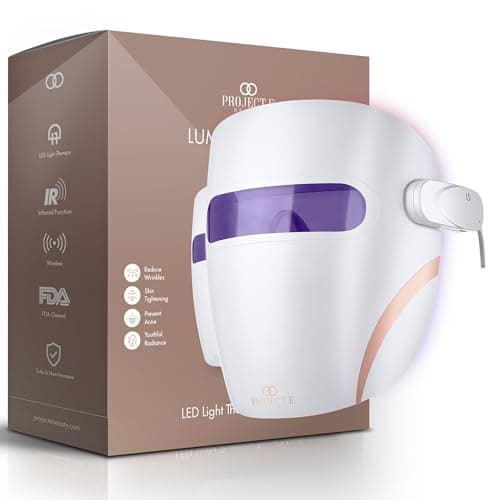
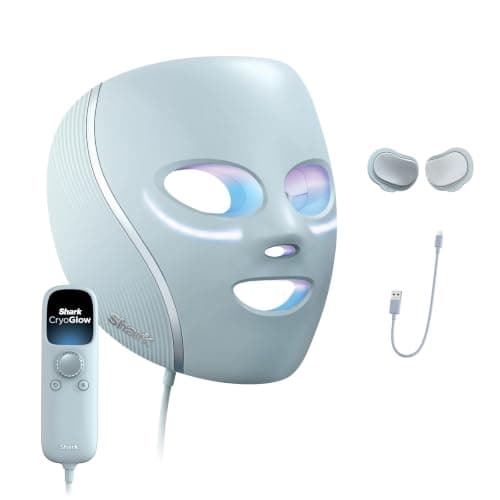
Buy the Shark CryoGlow. At a fixed ceiling, value stops being a tiebreaker and becomes the question — and the CryoGlow delivers red, blue and infrared programs plus a genuinely useful under-eye cooling function for well under the price of the boutique specialists. The budget pick is the Project E Beauty LED Light Therapy Mask, at roughly a third of the price of the leaders: lower output and a cheaper build, but it includes the two wavelength families that actually have literature behind them, which makes it the honest way to discover whether you will use a mask at all before spending real money.
Every price in the comparison table below comes from the live Amazon price layer and renders with its own "as of" date. All four picks carried a live price under the band at the last check. We never write a device price into copy — in a category where discounting is this aggressive, a number in prose is wrong within a week.
Why $500 and not $200
Because $200 is not a real band in this category yet, and we would rather say so than build a page around one product. Of the five masks in our registry, exactly one sits under $200. A "best under $200" page would be a single recommendation wearing a ranking costume, and the autocomplete demand for it does not change that. At $500 there are four genuine options and one meaningful exclusion, which is what makes the comparison worth reading.
What the cap excludes, and it is not nothing
One mask: the CurrentBody LED Light Therapy Face Mask Series 3. It is the most capable device in our registry on the two specifications that matter most — six published wavelengths from 415 to 1072 nm, and a flexible silicone body with extended chin coverage that conforms to a range of face shapes, so light actually reaches the sides of the nose and the jaw. Rigid masks do not do that well, and fit is a dose problem rather than a comfort problem: light that is not touching skin at a consistent distance is not being delivered.
So the honest statement of the trade is: under $500 you give up the best fit and the widest wavelength range in the category.What you do not give up is the part with the strongest evidence — red around 630 nm and near-infrared around 830 nm — which every mask on this page provides in some form. The three extra wavelengths on the excluded mask carry far thinner evidence than the two you are keeping. That is a defensible place to draw a line, and it is why we think the band is a sensible one rather than a compromise. Its full case is on the unconstrained roundup.
What the evidence actually supports
Photobiomodulation is a non-thermal process in which light is absorbed by chromophores in the mitochondria, and published reviews associate that with fibroblast proliferation, collagen synthesis and extracellular matrix production. That mechanism is real and reviewed. Reviews also consistently state the limits: optimal dosing and long-term safety still need more study, study populations are typically small, and consumer masks deliver lower irradiance than the clinic devices most of the literature used.
Translated into buying advice, in the order that matters:
- Daily sunscreen. Strongest evidence in all of skincare, costs a rounding error against any mask on this page. The roundup.
- A retinoid. Decades of literature, a few dollars a month. The roundup.
- Then, if you want the next incremental thing, an LED mask. Plausible, low-risk, slow, and expensive.
If steps one and two are not already in place, every mask on this page is the wrong purchase and we would rather lose the sale than pretend otherwise. Our are skincare devices worth it page takes that argument apart device by device.
How we ranked these
- Value at the ceiling — scored first on this page, unlike on the parent roundup. At a fixed cap, what you get per dollar is the question being asked.
- Wavelengths — published figures in nanometers, and whether red and near-infrared are both present. A mask that will not publish nanometers cannot be checked against the research.
- Coverage and fit — LED count, spread, and whether the shell holds a consistent distance from the skin.
- Adherence — session length and faff. A three-minute mask used five times a week beats a twelve-minute mask used twice, and this is the specification that most often decides outcomes.
The specification that decides the outcome is not on the box
It is irradiance — how much light energy actually reaches a square centimeter of skin — and almost no consumer mask publishes it. LED count is a proxy for it and a poor one, because a mask can have 500 weak diodes or 150 strong ones. Session length is the other half of the dose equation: energy delivered is irradiance multiplied by time.
Since you cannot check irradiance, the two things you can check are the ones we score: published wavelengths, and whether the mask holds a consistent distance from your skin. Everything else in this category is marketing with a number attached.
What to expect, on what timescale
| Timescale | Realistic expectation |
|---|
| First session | Nothing, except a pleasant ten minutes. Any immediate change is the cooling function or the lying down |
| 4 weeks | Possibly a slight change in how skin looks in photographs. Possibly nothing |
| 12 weeks, used 4-5 times a week | This is the point at which the published studies measured changes in roughness and epidermal uniformity. Modest changes |
| Ever | Not a substitute for a retinoid, not a substitute for sunscreen, and not a facelift |
Safety, in plain terms
LED red-light phototherapy is regarded in the published reviews as safe and non-invasive, and it does not cause the DNA damage UV does. The practical cautions are short and worth following: use the supplied eye protection or keep your eyes closed, do not use a mask if you are taking a photosensitising medication without asking your doctor first, and stop if you get persistent redness or a headache. Anyone with a history of melasma should treat the heat as the variable to watch rather than the light — heat is a known melasma aggravator, and the cooling function on our top pick is relevant here rather than decorative.
Where the money is better spent, if you are honest
At the top of this band you are spending the equivalent of several years of sunscreen, a decade of adapalene, or every single product in our under-$50 device roundup combined. That is not an argument against buying a mask; it is an argument for buying it in the right order. People who buy the device first and the sunscreen never are the reason this category has the reputation it does.
And if the appeal is partly the ten minutes lying down with something on your face, say so — it is a legitimate reason to buy a thing, and it is also available for twenty dollars from an ice roller or a gua sha.