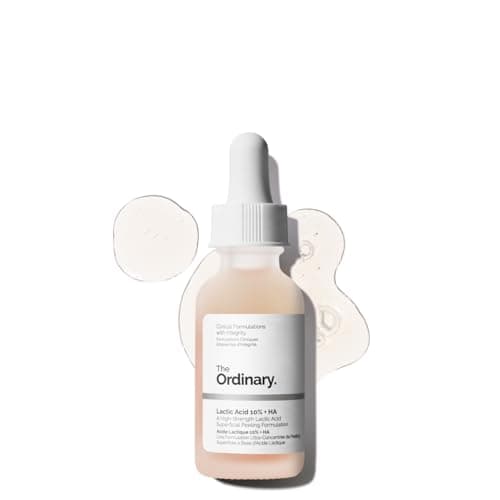
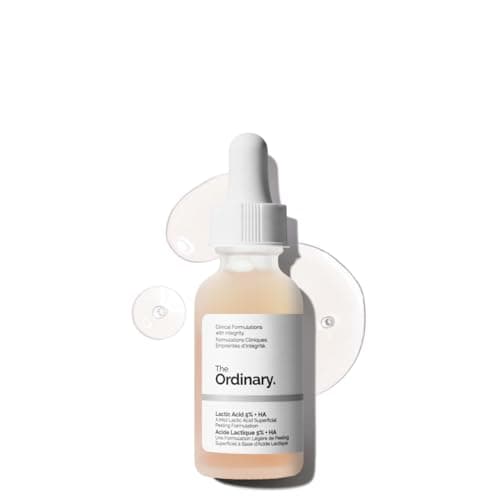
Lactic acid is an alpha hydroxy acid that loosens the bonds holding dead cells to the surface of your skin, so they shed instead of accumulating. The result is smoother texture, a bit more light bouncing off the surface, and — over months — a modest improvement in fine lines and uneven tone. It does the same job as glycolic acid, more slowly and more kindly, because its molecule is larger and penetrates less aggressively.
That is the whole pitch, and the gentleness is the point. Lactic acid is the acid we point people to first, because the most common failure in exfoliation is not choosing a weak product — it is choosing a strong one, using it too often, and giving up on acids entirely after two weeks of stinging. A 5% lactic used twice a week for three months will do more for your skin than a 30% peel used once in frustration.
What it actually does
Two things, and they are worth separating. First, exfoliation: lactic acid interferes with the corneodesmosomes — the protein rivets between dead surface cells — allowing them to release. That is the mechanism behind every AHA, and it is why the effect is textural before it is anything else. Second, and unusually, hydration: lactic acid is a component of your skin's own natural moisturizing factor, so it also behaves as a humectant. No other common AHA does both.
That combination is why lactic acid suits dry and mature skin better than glycolic. Glycolic exfoliates harder and dries as it goes. Lactic exfoliates less and leaves water behind. If your skin is rough and tight, that difference matters more than the percentage on the label.
The strengths that matter
- 5% — the beginner strength. Tolerated by almost everyone from the first night, slow enough that you will not overdo it, and the right place to start if you have never used an acid.
- 10% — the step up, appropriate after a couple of months at 5% with no irritation. This is where most people plateau, and it is a perfectly good ceiling.
- Above 10% — professional territory. At-home formulas at 15% and beyond exist but the tolerability advantage that makes lactic worth choosing starts to disappear.
One thing to check that most people miss: pH. An AHA only works in an acidic vehicle, roughly pH 3.5 to 4. A serum that lists lactic acid but has been buffered up towards neutral to feel gentle is not exfoliating — it is a humectant with a marketing claim. Brands that state their pH are telling you something useful; brands that do not usually have a reason.
Lactic vs glycolic vs mandelic
The three common AHAs differ mainly by molecule size, and size determines how deep and how fast they act. Glycolic is the smallest: fastest results, most irritation, best for robust or oily skin. Lactic is in the middle: slower, hydrating, the sensible default. Mandelic is the largest: slowest, gentlest, the pick for reactive skin and for anyone prone to post-inflammatory marks. We cover the others in the glycolic acid and mandelic acid guides, and the AHA-versus-BHA decision in AHA vs BHA.
How to use it without wrecking anything
At night, on dry skin, after cleansing and before moisturizer. Twice a week to begin, holding there for a month before you consider a third night. Do not use it on the same night as a retinoid until you have months of evidence that your skin is fine with both, and do not layer it with benzoyl peroxide.
The non-negotiable part is sunscreen. AHAs measurably increase UV sensitivity for about a week after use, and exfoliating without daily SPF is a net loss — you are removing the top layer and handing what is underneath to the sun. If daily sunscreen is not happening yet, fix that first with our face sunscreen roundup and come back to acids later.
What it will not do
Lactic acid will not clear blackheads — those are inside the pore, and you need an oil-soluble BHA like salicylic acid to reach them. It will not fix deep wrinkles, it will not treat active acne, and it will not shrink pores. It smooths, brightens slightly, and hydrates. Sold honestly, that is plenty.