Skip to content
Barrier & Bloom

Single reviews · Reviews

Vanicream Moisturizing Cream review: subtraction as a formulation strategy

The cream defined by what is not in it. We decoded the list, weighed the missing ceramides honestly, and worked out exactly who this beats CeraVe for.

By Stephen V.Updated How we review
#ad

We earn a commission when you buy through our Amazon links, at no extra cost to you. It never changes a verdict, and we say so when the cheaper product is the better buy. How this works.

Verdict:the cream to buy when your skin reacts to things and you do not know which thing. Vanicream's formulation strategy is subtraction — no fragrance, no dyes, no lanolin, no parabens, no formaldehyde releasers, no essential oils, no botanical extracts — leaving a short, functional list of humectants, emollients and occlusives that does the job of a moisturizer and nothing else. It is our top pick for sensitive skin. It is not the best barrier-repair cream, and we will explain why.

The method, as on every page here: we did not lab-test this cream.We decoded the published INCI list, compiled Vanicream's documented specifications and allergen exclusions, and compared the formula against the other tub creams and sensitive-skin moisturizers we rank. Full method on how we review.

Who it is for

Three groups, clearly. Reactive and allergy-prone skin — this is a standard recommendation in patch-testing contexts precisely because it excludes the common contact allergens, which makes it a clean baseline while you work out what set you off. Eczema-prone and very dry skin, where the thick occlusive base does real work. And anyone rebuilding after over-doing actives — see our guide to a damaged skin barrier, where a bland cream is the entire prescription for a fortnight.

It anchors our best skincare for sensitive skin and appears in our rosacea picks for the same reason: nothing in it is a common trigger.

The ingredient list, decoded

After water, the formula runs on petrolatum — a highly effective occlusive and the reason the cream reduces water loss as well as it does — plus sorbitol and glycerin as humectants, and cetearyl alcohol, ceteareth-20 and propylene glycol forming the emollient and emulsifier structure. Simethicone and sodium hyaluronate round it out, with sorbic acid as the preservative and BHT as an antioxidant.

That is close to the entire list, which is the point. Every ingredient is doing a structural job — pull water in, fill the gaps, seal it — and there is no active, no botanical, no fragrance component and no marketing ingredient anywhere in it. For a person trying to identify what their skin objects to, a formula with nine functional ingredients is far more useful than one with forty.

Two honest notes. There are no ceramides in it, and that is a real difference from CeraVe rather than a technicality — if your barrier is depleted rather than simply irritated, a cream supplying the actual missing lipids has a mechanistic advantage. And propylene glycol is itself an occasional contact allergen; it is uncommon, but on a product marketed for reactive skin it is worth knowing that "free of the common allergens" is not the same as "free of all of them."

How it compares

Against CeraVe Moisturizing Cream — the comparison everyone is actually making — CeraVe wins on barrier repair, because three ceramides plus cholesterol plus phytosphingosine is a more complete lipid story, and it wins on value per ounce. Vanicream wins on minimalism: a shorter list, no ceramide-carrier system, and a stronger occlusive base. If your skin is dry, buy CeraVe. If your skin is reactive, buy Vanicream. If it is both, start with Vanicream and add ceramides once things are calm.

Against La Roche-Posay Toleriane Double Repair, Vanicream is heavier, plainer and cheaper; LRP is a nicer daily facial lotion with niacinamide and ceramides but not enough occlusion for genuinely dry skin. Against plain petrolatum, Vanicream is far more pleasant to use and adds humectants; petrolatum alone seals better and costs almost nothing, which is a fair argument for very dry patches only.

The full comparison across textures is in best face moisturizers, and the dry-skin specific ranking is in best skincare for dry skin.

01
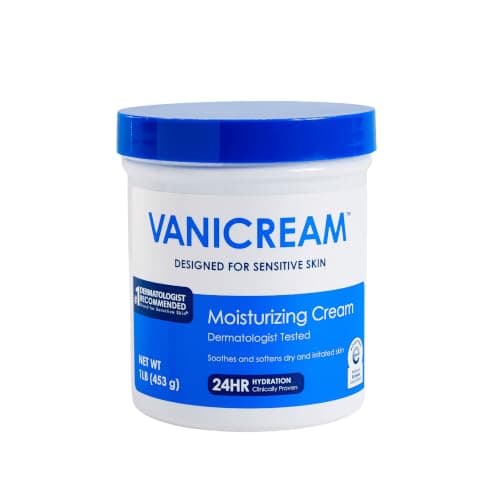
Vanicream Vanicream Moisturizing Cream

Best for reactive and allergy-prone skin

Vanicream Moisturizing Cream

Petrolatum-based occlusiveGlycerin + sorbitol + sodium hyaluronateNo fragrance, dye, lanolin or parabens16 oz tub
8.5/10

A deliberately minimal tub cream — petrolatum, glycerin, sorbitol and little else — free of fragrance, dyes, lanolin, parabens and formaldehyde releasers. The best baseline for reactive or allergy-prone skin, and a strong occlusive for very dry skin. No ceramides, which is the one real gap.

Gentleness
10
Occlusion
9
Barrier repair
7
Value
8

Pros

  • One of the shortest functional ingredient lists in the category
  • Excludes the common cosmetic contact allergens by design
  • Strong occlusive seal — genuinely effective on very dry and eczema-prone skin
  • Large tub at a low cost per ounce for face and body

Cons

  • No ceramides, so it seals the barrier rather than rebuilding it
  • Thick and slow to absorb; not a morning-under-makeup cream
  • Contains propylene glycol, itself an occasional allergen

Don't buy this if…

your problem is a depleted barrier rather than reactivity — a ceramide-led cream supplies the lipids your skin is actually short of, and this one does not.

The reason this cream keeps appearing in dermatology recommendations is not that it is clever. It is that it is uneventful: when you need a moisturizer that cannot plausibly be the cause of a reaction, a nine-ingredient petrolatum cream with no fragrance is exactly the tool. Used as a two-week reset while everything else comes out of your routine, it is close to unbeatable.

The judgment call is what comes next. Once your skin is calm, a ceramide cream will generally serve you better long-term because it addresses the lipid deficit rather than just covering it. Plenty of people keep both — Vanicream for flare-ups and body, a ceramide cream for daily face.

$13.19View on Amazon

$14.7711% off

Price as of Aug 28, 2026. Prices change — Amazon's at checkout is the one that counts.

#ad · we may earn a commission from this link to Vanicream Moisturizing Cream

How we picked

We did not lab-test this gear

Everyone in this category says they tested twenty products. We have not lab-tested any of these, and we say so. What we did instead: compiled the published specifications, decoded the ingredient (INCI) lists active by active, ran the math where there was math to run, and scored each product against a published rubric. The scores are judgments from documented research — not measurements we took, because we do not have a lab and we will not pretend we do. Where a number came from someone else's work, we name them in Sources.

Questions

Frequently asked

Is Vanicream Moisturizing Cream good for sensitive skin?
It is our top pick for it. The formula deliberately excludes fragrance, dyes, lanolin, parabens, formaldehyde releasers and botanical extracts, which removes most of the common causes of cosmetic contact reactions. That makes it a reliable baseline when you are trying to work out what your skin objects to.
Vanicream or CeraVe — which is better?
Different strengths. CeraVe wins on barrier repair because it supplies three ceramides plus cholesterol, and it is better value per ounce. Vanicream wins on minimalism and occlusion, which matters more if your skin is reactive rather than simply dry. Reactive skin, start with Vanicream; dry skin, start with CeraVe.
Does Vanicream contain ceramides?
No. It works by sealing water in with petrolatum and drawing it in with glycerin and sorbitol, rather than by supplying the barrier lipids themselves. That is a genuine difference from ceramide creams and the main reason it is not our overall moisturizer pick.
Can you use Vanicream on your face?
Yes, though it is thick and slow to absorb, so most people prefer it at night or during a flare-up. It works well on the body and hands too. If you want a Vanicream product that layers under sunscreen in the morning, the brand's lighter Daily Facial Moisturizer is the better format.
Is Vanicream non-comedogenic?
It is formulated to be, and it is widely used on acne-prone skin during treatment with drying actives. That said, it is a heavy petrolatum-based cream — if you are breakout-prone and using it across your whole face daily, a lighter ceramide lotion is a lower-risk choice.

Keep reading

Receipts

Sources

We do not run a testing lab, and we do not pretend to. Where a measured number came from someone else's work, we name them and link them. Where we could not verify something, we say so on the page rather than quietly leaving it out. Read our full method.