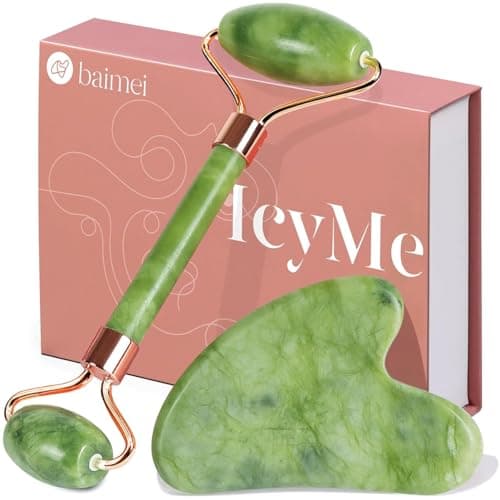
Buy it, and buy it because it is cheap enough to find out. The BAIMEI IcyMe set is the rank-1 pick on our gua sha roundup for an honest reason: it is a smooth stone and a working roller for less than the price of one mid-range tool, which makes it the right way to discover whether you are the sort of person who will actually do this. What it does is produce a small, temporary change in how contoured and de-puffed your face looks, plus ten minutes that most people find genuinely pleasant. What it does not do is lift anything permanently, drain anything in a medical sense, or change your skin.
The interesting part of this review is that the two halves of the set are not interchangeable, and that is not our opinion. There is one randomized controlled trial comparing facial gua sha against a facial roller head to head, published in the Journal of Cosmetic Dermatology in 2025, and it found the two tools moved different measurements. That trial is the spine of this page.
What the one trial actually measured
Ahn and colleagues randomized 34 women aged 20 to 50 to either gua sha or a facial roller, using a dual-function tool, for ten-minute sessions, five times a week, for eight weeks — a target of 40 sessions. One roller participant dropped out, so 33 were analyzed, 17 in the gua sha arm and 16 in the roller arm. Three outcomes were measured: facial contour (surface distances), muscle tone (oscillation frequency and dynamic stiffness) and skin elasticity.
The split is the finding:
- Contour: both worked, neither won. Both groups improved significantly over the eight weeks. The gua sha arm reduced the four measured surface distances by 2.23 to 2.40 mm; the roller arm reduced them by 2.75 to 3.26 mm. The between-group difference was not statistically significant.
- Muscle tone: only the gua sha moved it. Oscillation frequency fell by 2.02 Hz and dynamic stiffness by 56.46 N/m in the gua sha arm. The roller arm showed essentially no change in either, and the between-group differences were significant.
- Elasticity: only the roller moved it. Gross elasticity rose 8.6% and biological elasticity 7.5% in the roller arm. The gua sha arm showed no significant change in either, and again the between-group differences were significant.
The authors' own reading is that both techniques improve contour by different routes — the stone acting mainly on muscle properties, the roller mainly on skin elasticity. For a product that puts both tools in one box, that is the most useful thing anyone has published about this category.
Now the caveats, because they are large
We are going to state the limits twice, and this is the first time. This is one small, short trial, and it never tested the thing this product invites you to do.
- There was no combined arm.Nobody in that study used both tools. So "buy the set and use both for the best of both results" is an inference, not a finding, and the authors list the missing third arm as a limitation themselves.
- Seventeen and sixteen people, for eight weeks. The authors flag the small, healthy, women-only, 20-to-50 sample and say eight weeks may not show whether anything is sustained or cumulative.
- No no-treatment arm. Both groups massaged their faces for ten minutes a day. The trial compares two tools against each other, not either tool against doing nothing — so some of the shared contour improvement may belong to the massage, the time, or the attention rather than to the implement.
- No standardized clinical photographs. The changes are instrument readings in millimeters, hertz and newtons per meter. Whether they are visible in a mirror is a separate question the trial did not answer.
- The wider literature is thin. A 2023 letter in the same journal reviewing gua sha, jade rollers and facial massage concluded that the proposed benefits beyond blood flow are not well understood and that further research is warranted. That is the honest state of the field.
And the claim we will not repeat: lymphatic drainage. The phrase is everywhere in this category, including on this product's own listing. The circulation work most often cited for it used firm traditional gua sha on the back, in a handful of people, with no control group, and found a temporary effect. Extrapolating that to a jawline is marketing. The de-puffing you see in the morning is real and it is short-lived; our ice roller versus gua sha page separates the two mechanisms properly.
The protocol is the actual product
Ten minutes, five days a week, eight weeks. Forty sessions. That is what produced the numbers above, and it is far more than most people who buy a gua sha will ever do. This is the single most useful thing to know before spending anything in this category, and it is also the strongest argument for this particular set: the cheapest possible tool is the right first purchase when the binding constraint is your own consistency, not the stone. If you get to week eight, upgrade to something you enjoy holding. If you stop in week two, you have lost almost nothing.
It is the same logic we applied to the cheap-device page and to are skincare devices worth it: the expensive version of a tool you will not use is not better value than the cheap version of a tool you will not use.
What you are actually getting
Two pieces: a flat gua sha stone and a two-ended roller, listed as jade or stone. A note on that word — "jade" is a material claim nobody verifies at this price, and it does not matter as much as the listing implies. What matters mechanically is that the edge is smooth, the surface is non-porous enough to wipe clean, and the piece stays cool to the touch. All three are true here. What you give up against a heavier premium stone is heft and the feel of the thing in your hand, which is a real difference and a purely sensory one.
The non-negotiable: slip. Dragging a stone across dry skin is how you tug, redden and irritate your face, and it is the only way this tool can do harm. Use it over a facial oil, a slippery serum or a cream — our face oil roundup covers the cheap options — and move outward and upward with light pressure. If you see a red line where the edge went, you used too much pressure and too little slip.
One more honest note on hygiene. A stone that lives on a bathroom shelf and touches a face covered in oil needs washing, not just wiping. Soap and water after use, dried properly. This is unglamorous and it is the difference between a tool and a fomite.
How it compares
| Tool | What the evidence supports | What it costs you |
|---|
| This set: gua sha stone plus roller | Small contour change; the stone moved muscle-tone measures and the roller moved elasticity measures in the one head-to-head trial | Ten minutes a day to get there; basic materials; no heft |
| A premium single stone | The same mechanism, nothing more | Several times the price for weight and feel |
| An ice roller | Vasoconstriction within about a minute, visibly less puffy for an hour or two, nothing cumulative | Freezer space, and no contour claim at all |
| A microcurrent device | A different and more contested claim about muscle stimulation | Twenty to forty times the price, plus conductive gel as a consumable |
| Doing nothing | Nothing — but the trial never tested this, which is the gap | Free |
Who should not buy it
- Anyone with active, inflamed acne or a compromised barrier. Dragging a stone over inflamed skin spreads it and makes it worse. Treat first; see the acne routine and damaged skin barrier.
- Anyone with rosacea or easily flushed skin. The mechanism is mechanical stimulation and increased blood flow, which is the opposite of what reactive skin wants.
- Anyone expecting a lift. Millimeters of surface distance over eight weeks of daily work is not a facelift, and no stone will be.
- Anyone who wants a substantial object. If part of the appeal is the ritual and the weight in your hand, spend more — the premium rose quartz piece on the roundup is genuinely nicer to hold, and nicer to hold is a legitimate reason to buy a thing whose benefits are partly the ten minutes.