Skip to content
Barrier & Bloom

Explainers · Learn

How much sunscreen to apply (most people use a quarter of it)

SPF is tested at a thickness almost nobody uses. The two-finger rule, the quarter-teaspoon measure, and the reapplication schedule that decides whether your SPF 50 behaves like one.

By Stephen V.Updated How we review
#ad

We earn a commission when you buy through our Amazon links, at no extra cost to you. It never changes a verdict, and we say so when the cheaper product is the better buy. How this works.

For your face and neck, use about a quarter of a teaspoon — roughly two full finger-lengths of product squeezed from the tube. For your whole body, about a shot glass, or 30ml. Most people apply between a quarter and half of that, which is the single biggest reason sunscreen underperforms in real life.

This matters because SPF is not a linear rating you get some fraction of. It is measured in a laboratory at 2 milligrams per square centimeter of skin, a genuinely thick layer. Apply half that and you do not get half the protection — the relationship is closer to exponential, and an SPF 50 applied at half thickness behaves something like an SPF 15. You paid for the higher number and are wearing the lower one.

The two-finger rule

Squeeze sunscreen in two lines along your index and middle fingers, from the base of each finger to the tip. That is approximately the right amount for face and neck, and it will look like far too much. It is not. Apply it in two layers if a single pass feels heavy — one, wait a minute, then the second — which is easier to spread and gets you to the same thickness.

The rule is an approximation rather than a measurement, and it is more useful than a measurement because you will actually use it. If you prefer numbers: a quarter teaspoon for the face, a further quarter for neck and ears if you are being thorough.

The bits everyone misses

  • Ears — particularly the tops and the rims, one of the more common sites for sun damage.
  • The back and sides of the neck, and the chest if it is exposed.
  • Eyelids and under-eyes — a genuinely high-risk area that people skip because sunscreen stings. Use a stick or a mineral formula there rather than nothing.
  • The hairline and any parting, plus a thinning crown.
  • The backs of the hands, which age faster than almost anywhere else and are almost never protected.

Reapplication, honestly

The guidance is every two hours of sun exposure, and immediately after swimming, sweating heavily or toweling off. That is the number to work to when you are outdoors.

For an ordinary indoor day — commute, office, commute — reapplying every two hours is not realistic and is not what the risk profile demands. A sensible compromise most dermatologists will recognize: apply properly in the morning, and reapply once around midday if you have been outside at all or you sit next to a window. UVA passes through glass, so a desk by a window is not the neutral environment it feels like.

Reapplying over makeup is the practical obstacle, and the honest answer is that a powder or a mist does not deliver anything like the required thickness. If reapplication matters to you, a stick or a fluid you can press over makeup is a better purchase than a powder.

Does a higher SPF let me use less?

No — and this is the trap. SPF 50 tested at full thickness gives you more margin than SPF 30, but the number assumes the full amount. If a higher SPF makes you feel licensed to apply a thin layer, you have converted a genuine advantage into a deficit. Buy the SPF you like the feel of, and apply enough of it. Feel is not vanity here: the sunscreen you enjoy wearing is the one you will apply generously and reapply, and that outperforms a superior formula you ration.

Formats that make the quantity survivable

The two picks below are the two formats that solve the practical problem. A large-volume fluid makes the morning application generous rather than precious — when a bottle costs little and holds a lot, you stop rationing. A clear, fast-drying gel makes midday reapplication realistic, including over makeup.

For the full ranked field, our best face sunscreen roundup covers mineral and chemical options at every price, and chemical vs mineral sunscreen explains which filter type suits which skin.
The short answer

Quick picks

#ProductBest forScorePrice
01
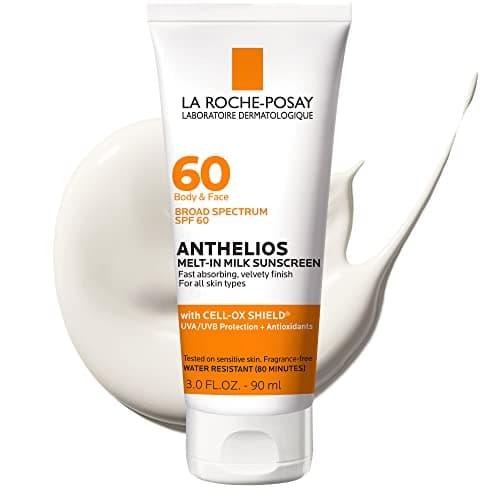
La Roche-Posay La Roche-Posay Anthelios Melt-In Milk SPF 60
La Roche-Posay Anthelios Melt-In Milk SPF 60

The format that solves the quantity problem: a large-volume fluid that spreads easily and costs little enough per ounce that you will apply the full amount instead of rationing it.

Best for applying enough
8.4
$25.99Amazon
02
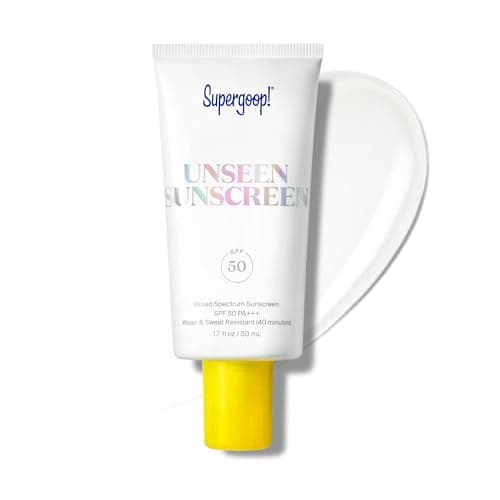
Supergoop! Supergoop! Unseen Sunscreen SPF 50
Supergoop! Unseen Sunscreen SPF 50

The format that solves reapplication. A completely clear gel that dries matte and sits over makeup without disturbing it — which is the only realistic way most people will manage a midday second coat.

Best for reapplying midday
8.0
$38.00Amazon

#ad · Live prices from the Amazon Product API, as of Aug 28, 2026. Where we have no verified live price, we show none — a gap beats a number that has rotted.

In detail

The picks, in full

01
La Roche-Posay La Roche-Posay Anthelios Melt-In Milk SPF 60

Best for applying enough

La Roche-Posay Anthelios Melt-In Milk SPF 60

SPF 60 broad spectrumWater resistant 80 min5 fl ozFace and body
8.4/10

The format that solves the quantity problem: a large-volume fluid that spreads easily and costs little enough per ounce that you will apply the full amount instead of rationing it.

Protection
9
Efficacy
9
Gentleness
7
Texture
8
Value
9

Pros

  • Big bottle at a fair price, which is what actually drives generous application
  • Spreads easily enough to layer twice without a heavy finish
  • Genuine 80-minute water resistance for outdoor days

Cons

  • Slight sheen that oily skin may dislike on the face
  • Fragranced

Don't buy this if…

you need something invisible under makeup — the gel below is the better format for that.

$25.99View on Amazon

Price as of Aug 28, 2026. Prices change — Amazon's at checkout is the one that counts.

#ad · we may earn a commission from this link to La Roche-Posay Anthelios Melt-In Milk SPF 60

02
Supergoop! Supergoop! Unseen Sunscreen SPF 50

Best for reapplying midday

Supergoop! Unseen Sunscreen SPF 50

SPF 50 chemicalClear gelMatte finishFragrance-free
8.0/10

The format that solves reapplication. A completely clear gel that dries matte and sits over makeup without disturbing it — which is the only realistic way most people will manage a midday second coat.

Protection
9
Efficacy
8
Gentleness
8
Texture
10
Value
5

Pros

  • Genuinely invisible at every skin tone, so a second coat is not a decision
  • Works over makeup as well as under it
  • Doubles as a primer, which removes another excuse

Cons

  • Expensive per ounce, which works against applying enough
  • Silicone-heavy feel is divisive

Don't buy this if…

the price would make you apply a thin layer. Under-applying an expensive sunscreen is worse value than applying a cheap one properly.

$38.00View on Amazon

Price as of Aug 28, 2026. Prices change — Amazon's at checkout is the one that counts.

#ad · we may earn a commission from this link to Supergoop! Unseen Sunscreen SPF 50

How we picked

We did not lab-test this gear

Everyone in this category says they tested twenty products. We have not lab-tested any of these, and we say so. What we did instead: compiled the published specifications, decoded the ingredient (INCI) lists active by active, ran the math where there was math to run, and scored each product against a published rubric. The scores are judgments from documented research — not measurements we took, because we do not have a lab and we will not pretend we do. Where a number came from someone else's work, we name them in Sources.

Questions

Frequently asked

How much sunscreen should I use on my face?
About a quarter of a teaspoon for the face, or a further quarter if you are covering neck and ears too. The two-finger rule is the practical version: two lines of product along your index and middle fingers, base to tip.
What is the two-finger rule for sunscreen?
Squeeze sunscreen in two lines along your index and middle fingers, from base to tip, and use that for your face and neck. It approximates the quarter-teaspoon that laboratory SPF testing assumes. It will look like too much; it is not.
What happens if I do not apply enough sunscreen?
You get much less protection than the label promises, and not proportionally. SPF is measured at 2 mg per square centimeter — a thick layer. Applying half that leaves an SPF 50 behaving closer to an SPF 15, because the relationship between thickness and protection is closer to exponential than linear.
How often should I reapply sunscreen?
Every two hours of sun exposure, and immediately after swimming, heavy sweating or toweling. For an ordinary indoor day, applying properly in the morning and reapplying once around midday is a realistic compromise — bearing in mind UVA passes through window glass.
Can I use a higher SPF and apply less?
No. The SPF number assumes the full test thickness. Treating a higher number as license to apply a thin layer converts an advantage into a deficit. Buy the sunscreen whose texture you like, and use enough of it.

Keep reading

Receipts

Sources

We do not run a testing lab, and we do not pretend to. Where a measured number came from someone else's work, we name them and link them. Where we could not verify something, we say so on the page rather than quietly leaving it out. Read our full method.