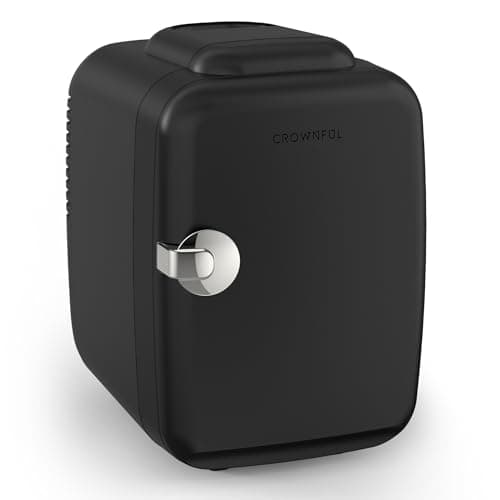
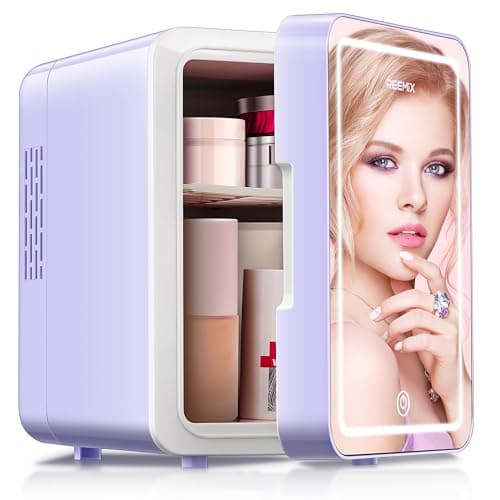
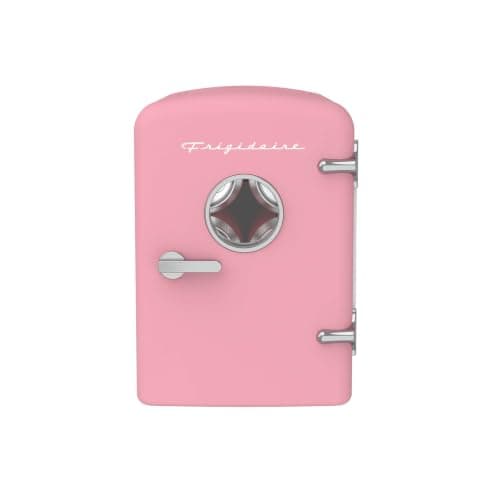
Buy the Frigidaire Retro 9-Can. It is the roomiest unit under the ceiling and, as it happens, the cheapest one too — so it is both our top pick and the budget pick, which is not something we get to write often. It is sold as a beverage fridge rather than a skincare fridge, it uses the identical thermoelectric cooling element as every cosmetic-branded box in this class, and it gives you roughly half again as much room for less money. If the fridge is going anywhere other than a dressing table, this is the one.
Unlike most price bands, fifty dollars does real work in this category. It takes out the single most recognizable cosmetic fridge on the market — the Cooluli Classic 4L, which we review separately and which sits above this ceiling — and it takes out everything in the compressor class. What is left is three thermoelectric units with the same mechanism inside, which means the entire decision is footprint, capacity and whether you want a mirror in the lid. Every price in the table below comes from our live price layer and carries its own "as of" date, so you can check the band rather than take our word for it.
Before you buy: what a fridge does and does not do for skincare
It does two things. It slows the degradation of a handful of genuinely unstable products — an L-ascorbic acid serum, a retinal emulsion, anything with live-culture framing — and it makes a gel, an eye cream or a roller feel cold on the face, which is a real and underrated reason to use something consistently. It does not make a stable product work better, and it does not extend the life of an opened bottle of moisturizer in any way you will notice.
One thing to know before you plug anything in: a thermoelectric cooler holds its interior somewhere in the region of fifteen to twenty degrees below the room it is standing in. That is not a refrigerator and it is not a thermostat. In a warm bathroom it will run considerably warmer than the number on the box, which matters if you bought it for a serum rather than for the feel of a cold cream. Our full skincare fridge guide covers what belongs inside one and what should never go in it.
How we ranked these
- Liters per dollar. The cooling element is the same across all three, so interior volume is the one specification that genuinely varies with price.
- Footprint and where it can live. A 4-liter box fits on a dressing table and a 9-can box mostly does not. That is the real constraint, not capacity in the abstract.
- What the cosmetic premium buys. Where a unit costs more for an LED mirror or a nicer shell, we price that honestly as styling rather than as performance.
- Power options. All three take AC and 12V car power, and all three switch between cool and warm. Where that is identical, it cannot break a tie.
- Noise and heat. Thermoelectric units hum and vent warm air from the back. Anything destined for a bedside table is judged on that.
Scores are judgments from documented research — published specifications, manufacturer documentation and aggregated owner reports — not measurements we took, and how we review says so in those words.
The popular fridge that does not make the band
The Cooluli Classic 4L is the best-known cosmetic fridge on the market and it sits above this ceiling, so it is not ranked here. That is not a criticism of the product — it is a nicely finished 4-liter unit and we have reviewed it in full — it is the whole point of a price band. Against the three picks above it offers the same thermoelectric cooling, the same cool-and-warm switch and the same four-liter interior as two of them, for more money and a better-looking shell. If the finish matters to you, our Cooluli review has the detail. If the fifty-dollar line is firm, the CROWNFUL above is the same idea inside the band.
One other registry unit, the Chefman Iceman, had no verified live price at our last check, so we could not confirm it qualifies and have not ranked it. We would rather leave a gap than put a number on this page we cannot stand behind.
Which of the three you actually want
| If this is you | Buy | Why that one |
|---|
| You have shelf or floor space and want the most room | Frigidaire Retro 9-Can | Half again the interior of the others, for the lowest price in the band |
| It has to fit on a dressing table or a desk | CROWNFUL 4-Liter | Smallest footprint, same cooling, cheapest route into the 4-liter class |
| It is going on display and you would use a lit mirror | Reemix 4L with LED Mirror | The only purpose-built cosmetic fridge under the ceiling |
| You want to know whether you will use one at all | Frigidaire Retro 9-Can | Lowest price on the page, so the experiment costs the least |
What to put in it, and what not to
- Worth chilling: an L-ascorbic acid serum, a retinal or retinol emulsion, eye gels, sheet masks, and any tool you want cold — a roller or a gua sha stone straight out of a cold box is the cheapest upgrade available to a routine.
- Not worth chilling: cleansers, sunscreen, and anything oil- or butter-based. Oils thicken and separate when cold, and a chilled sunscreen is harder to spread evenly, which is the one mistake that actually costs you protection.
- Never: prescription medication that specifies a storage range. A thermoelectric cooler does not hold a set point, so it cannot satisfy one.
Where this page stops
This page is organized around the fifty-dollar ceiling. For the category without one — which includes the larger and better-finished units — read our best skincare fridge guide. If what you actually want to know is whether a "skincare fridge" is a different appliance from a mini fridge at all, the honest answer is on skincare fridge vs mini fridge. And if you are spending under fifty dollars on a device generally rather than on a fridge specifically, best skincare devices under $50 ranks a steamer, a roller, a cleansing brush and a gua sha stone against each other at the same ceiling — and ranks a different winner, because the question is different.
How we picked
We did not lab-test this gear
Everyone in this category says they tested twenty products. We have not lab-tested any of these, and we say so. What we did instead: compiled the published specifications, decoded the ingredient (INCI) lists active by active, ran the math where there was math to run, and scored each product against a published rubric. The scores are judgments from documented research — not measurements we took, because we do not have a lab and we will not pretend we do. Where a number came from someone else's work, we name them in Sources.